
One of the most basic properties to understand is that numbers are made by adding (or subtracting) separate numbers to (or from) one another. This is to say that a number can be constructed from two or more separate numbers AND numbers can be deconstructed from a singular number into two or more separate numbers. To see this concept in action, examine the following equation:
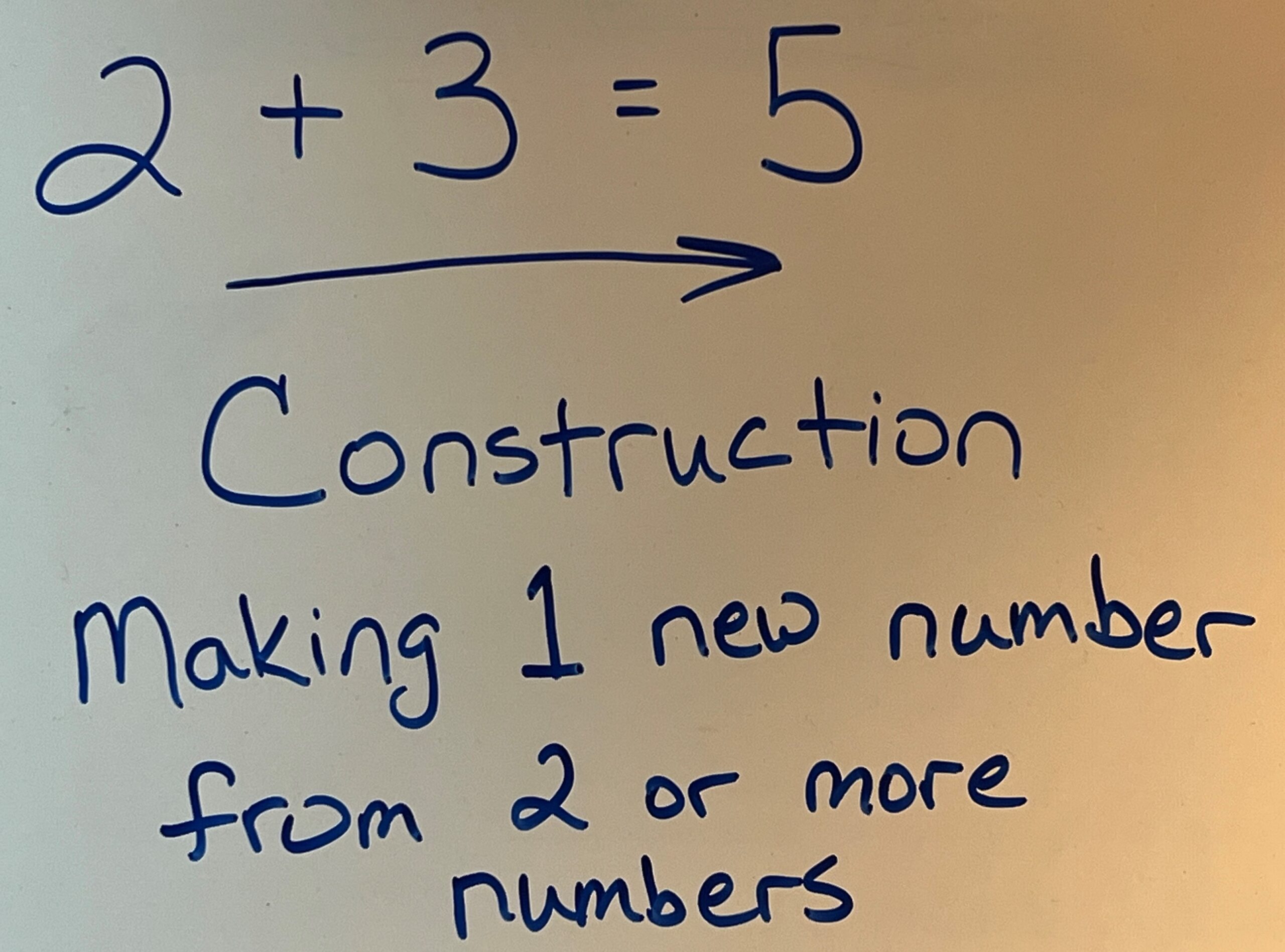
In this example, the ‘2’ and the ‘3’ are separate numbers and can be constructed (combined) to create the new number ‘5.’ While this may seem very elementary, the inverse of this process is also true:
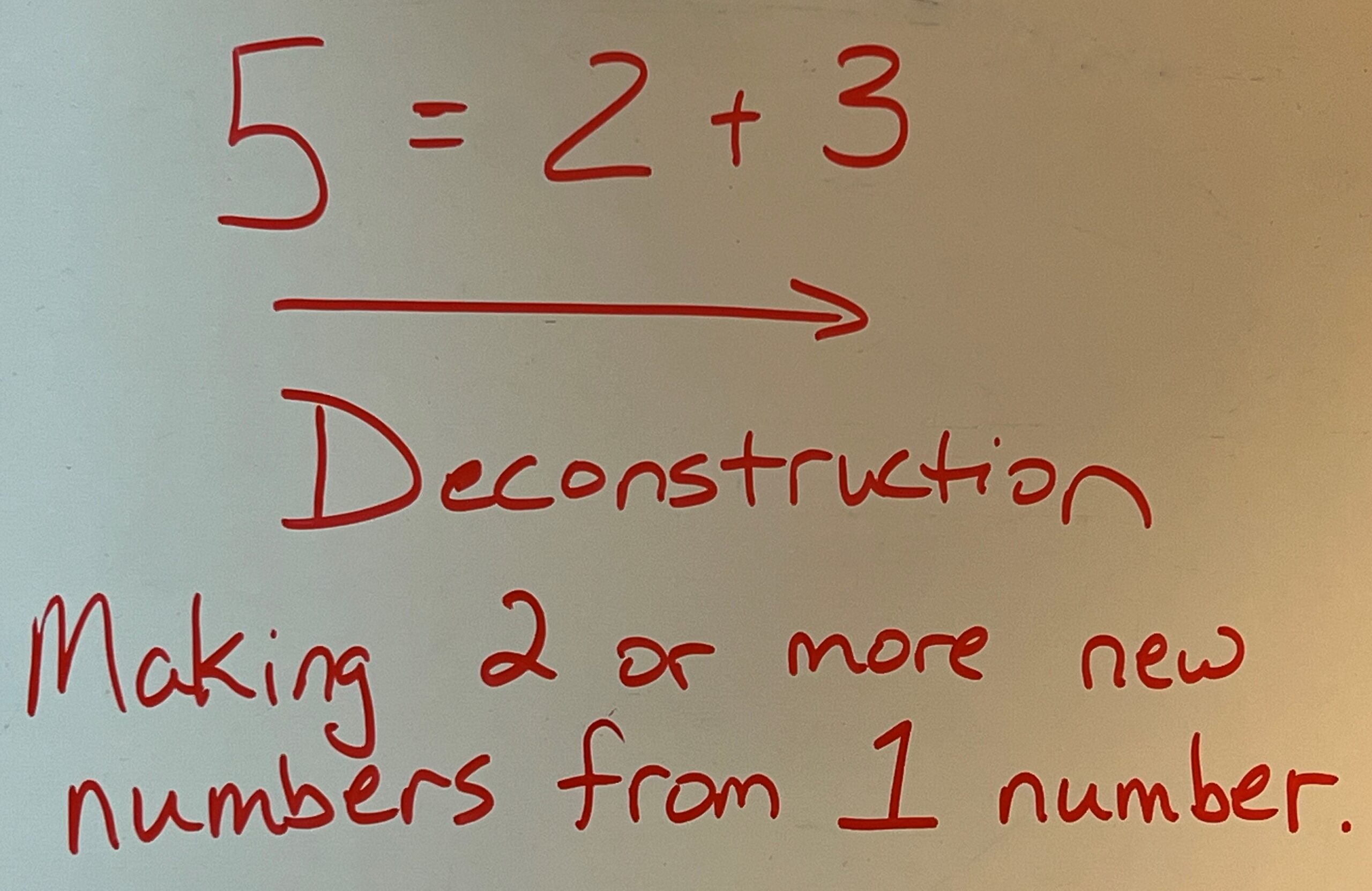
In this reversal, we see the ‘5’ has been deconstructed into the ‘2’ and the ‘3,’ which have had an addition sign added between them.
This concept can be used in connection with number sense when computing mental math problems. Let’s take a look at the following addition problem and compute its sum using deconstruction and reordering the numbers (incorporating the commutative and associative properties):
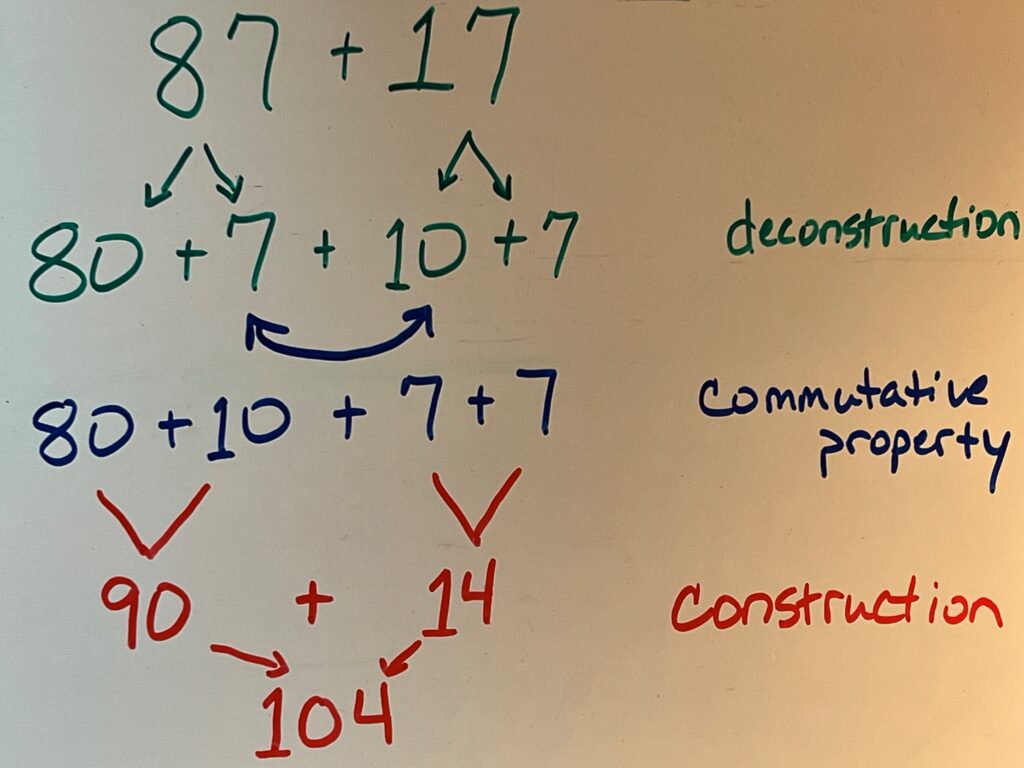
87 + 17
Because of the Additive Property of Numbers, I can deconstruct both of these numbers into separate numbers that may work better for me as a mathematician.
87 = 80 + 7
17 = 10 + 7
I can break the ‘87’ into ‘80 + 7’ and the ‘17’ into ‘10 + 7’ because of the Additive Property of Numbers. I can then rewrite the original expression ‘87 + 17’ with the deconstructed numbers in place of the original numbers:
80 + 7 + 10 + 7
I can now use the Commutative Property of Addition to rearrange the numbers, since all of the operations are addition. The Commutative Property allows me to rearrange the numbers in an addition problem without changing the result (notice that the ‘10’ and the ‘7’ changed positions in the expression).
80 + 10 + 7 + 7
This problem may look easier to me, because it moves the round numbers that end with ‘0’ in the ones place to be added together and then finishes the expression with the single digit addends that can easily be added using my addition fact fluency (‘7 + 7’). I can now use a count up strategy to add ‘80 + 10’ to make ‘90,’ and then add to that the ‘7 + 7’ to make ‘14,’ and combine the ‘90’ and ‘14’ to make ‘104.’
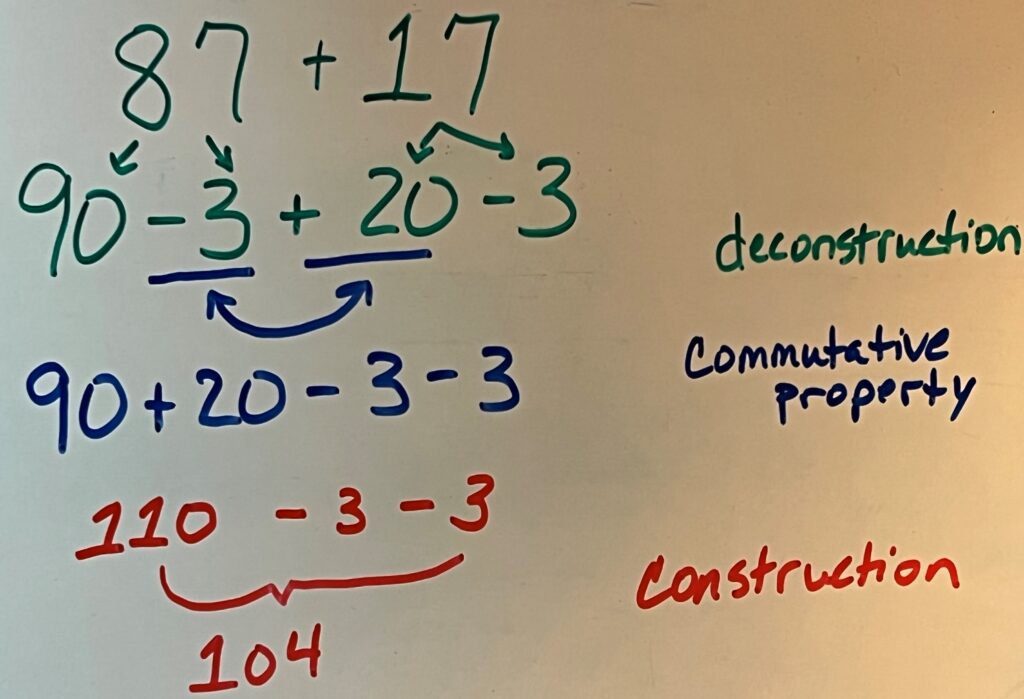
The Additive Property of Numbers also works with using subtraction to deconstruct numbers. Let’s examine the previous expression again:
87 + 17
This time, let’s deconstruct the numbers using a subtraction model:
87 = 90 – 3
17 = 20 – 3
This time, I can add the ‘90 + 20’ to get a sum of ‘110,’ but since my deconstruction utilizes subtraction, I need to subtract ‘3’ and then subtract ‘3’ again (because both deconstructed numbers had ‘- 3’ in them.
The Additive Property of Numbers allows me to use my number sense with regard to understanding where numbers are in reference to other numbers on the number line and my fluency in dealing with landmark numbers (like multiples of 10, 20, 50, or 100) to make my math work easier to do. When my number sense is developed, my simple calculations can be made with almost no effort, but for those who have poor number sense, this process seems tedious and leads to frustration.
Just as with any skill, practice makes perfect. If you are trying to increase number sense, first try constructing and deconstructing numbers. You will find that as speed develops in this skill, other skills will speed up as well. Consider the following number and some of its examples of deconstruction:
174 = 100 + 70 + 4
174 = 170 + 4
174 = 100 + 50 + 20 + 4
174 = 50 + 50 + 50 + 20 + 4
174 = 175 – 1
174 = 200 – 26
174 = 200 – 20 – 6
These are different ways to deconstruct the number ‘174.’ This list is NOT exhaustive. Depending on the math problem this number appeared in, a student may choose a different deconstruction than if it were in a different problem. But, as I mentioned earlier, developing this skill may very well have a positive impact on a person’s understanding of why numbers do what they do, thus increasing comfort level (or lessening anxiety) just a little bit to see positive results.
This is what I am here to help you with. I am here to help you learn Mathanese, because I speak Mathanese, and you will, too. The focus of my blog is to present you with strategies to practice computational facts, explanations of number sense reasoning to understand computational processes, and teach you the Mathanese terms you need to succeed as a mathematician. Choose a topic that is listed in the menu to learn more. If a topic you want to learn about isn’t available, send me an email and ask me to write something about it.
If you haven’t done so already, subscribe to my email list so that you can be notified when I publish new posts. If you have questions about anything in this post, please reach out and ask for clarification. Thank you for reading and have a great day.
Mr. H.