Teacher: Practice your math facts.
Student: Why do I have to memorize these?
Teacher: Because I said so…
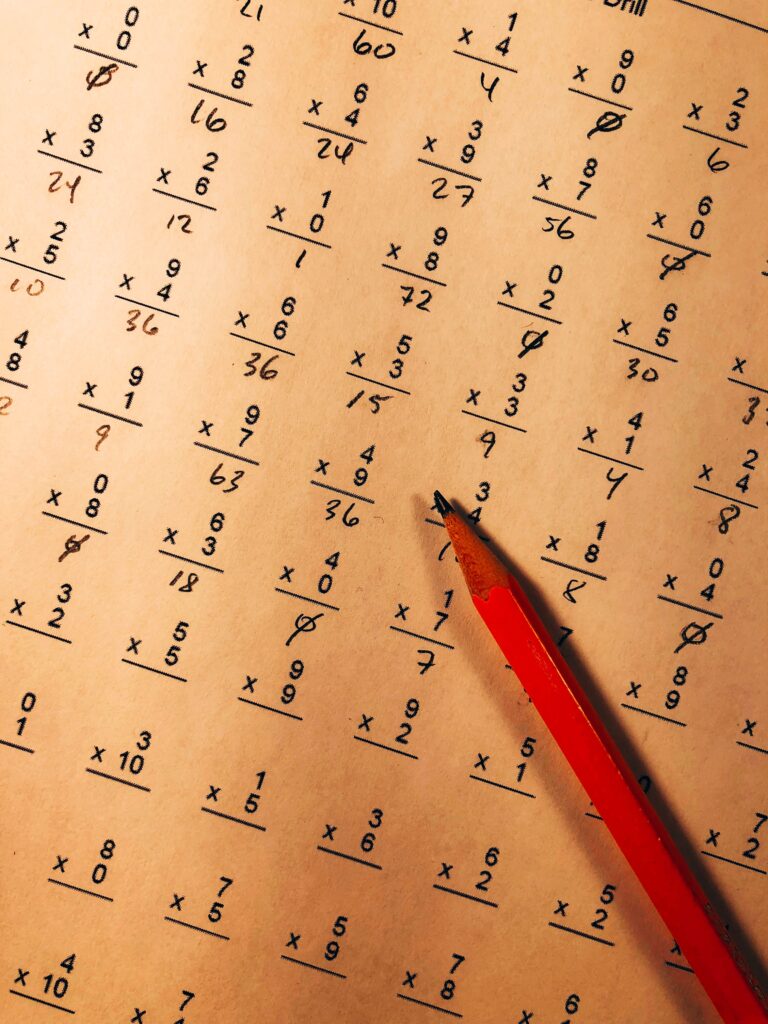
These words were all too true when I was in school many (MANY) years ago. I was the type to do as I was told, so I studied my math facts. Unfortunately, not everyone does. For whatever reason, absorbing the basic math facts of addition, subtraction, multiplication, and division is just a challenge. Personally, I had a challenge with my multiplication math facts for 7 and 8. They were my biggest challenge, so I avoided them. To this day, they are still my biggest struggle, but I do know them. Why am I talking about math facts, you ask. It’s simple.
Whenever you build something, you need to have a solid foundation on which to build. If you try to build something big and beautiful upon a shaky foundation, eventually it will crumble. Think about it, when a building is erected, extreme care is placed into its foundation. The same is true when building a house of playing cards or the base of a pyramid for cheerleading. If a landscaper doesn’t properly prepare the planting area for shrubs and flowers, they will not survive long. Farmers have to prepare the ground before planting seed or crops will not grow well. It’s all about the foundation.
There are only four things that can be done in math: addition, subtraction, multiplication, and division. These are called operations. Operations can only be calculated on two numbers at a time. Granted, people and machines alike can be so quick and efficient that it appears they are working with more than two numbers at times, but it’s just not true. The most complex mathematical calculations in the world can only be calculated by using two numbers and one operation at a time. Herein lies the importance of computational fluency (math facts).
When I teach students about fractions or negative numbers, the process always includes some new rules that are based on using basic computational fluency. When students have to stop in the middle of learning a new advanced process to remember math facts that were taught in previous years (but never committed to their memories), they are doing double the work. They are focusing on new content in the present lesson AND trying to activate prior knowledge from previous years’ lessons. This is where frustration kicks in and many students will get emotional and give up. In fact, I often see students demonstrate understanding of a process, but make errors in calculations. This frustrates them, despite my encouragement for understanding the process. What I then suggest is to practice the math facts that are slowing their progress, but they view that as…wait for it…additional work…Ugh!
Instead, I have made it a part of my students’ weekly work. Every week, my students must complete a 60-second assessment for each set of math facts. Those students who are fluent see their scores improve. Those students who are not ALSO see their scores improve. It is not a graded activity, but I do meet with students periodically, and talk with them about their progress (and give additional praise to those who have been struggling). This is not added to my lesson planning. This is a part of the morning work and needs to be completed sometime during the week (and logged inside the front cover of the students’ math notebooks). You can get my Free Fact Fluency Tracker right here.
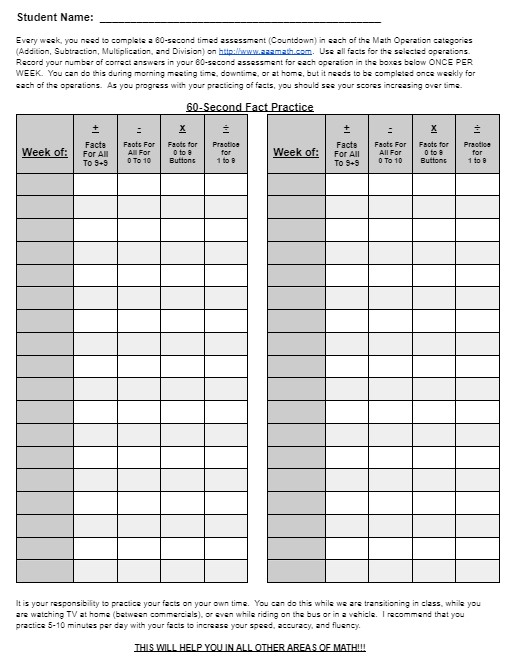
Computation fluency (math facts) is a key component to math success. I strongly encourage all learners who are trying to improve their math performance to work on their basic facts. Whether you use an online flashcard tool or if you use physical flashcards, the goal is to increase fluency (speed AND accuracy) to increase confidence. I will put emphasis on the ACCURACY side of fluency before speed, but ultimately, learners will want to make this key component a staple of their Mathanese learning experience.
This is what I am here to help you with. I am here to help you learn Mathanese, because I speak Mathanese, and you will, too. The focus of my blog is to present you with strategies to practice computational facts, explanations of number sense reasoning to understand computational processes, and teach you the Mathanese terms you need to succeed as a mathematician. Choose a topic that is listed in the menu to learn more. If a topic you want to learn about isn’t available, send me an email or post a comment and ask me to write something about it.
If you haven’t done so already, subscribe to my email list so that you can be notified when I publish new posts. If you have questions about anything in this post, please reach out and ask for clarification. Thank you for reading and have a great day.
Mr. H.