Back in October of 2022, I went into the hospital for 5 days with a nearly perforated colon. I was in so much pain, that I decided right there and then that I was not planning to experience that again. One of the steps that I needed to put into place was adding about 35 grams of fiber to my daily diet. I thought to myself, “OK…how hard can that be?” It’s actually kind of hard. I started doing some research into high-fiber diets, by searching up a list of high-fiber foods. Here is what I found:
Here are the top 10 high fiber foods:
- Legumes: This includes lentils, chickpeas, beans, and peas. They are a great source of fiber, with one cup of cooked lentils providing around 15.6 grams of fiber.
- Whole grains: Whole grains such as brown rice, quinoa, and oats are packed with fiber. One cup of cooked quinoa provides around 5.2 grams of fiber.
- Berries: Berries such as raspberries, blackberries, and blueberries are high in fiber and antioxidants. One cup of raspberries provides around 8 grams of fiber.
- Avocado: Avocado is a great source of fiber and healthy fats. One medium avocado provides around 10 grams of fiber.
- Chia seeds: Chia seeds are a great source of fiber and omega-3 fatty acids. One tablespoon of chia seeds provides around 5 grams of fiber.
- Nuts: Nuts such as almonds, pistachios, and pecans are high in fiber and healthy fats. One ounce of almonds provides around 3.5 grams of fiber.
- Broccoli: Broccoli is a good source of fiber and other nutrients. One cup of cooked broccoli provides around 5 grams of fiber.
- Sweet potato: Sweet potato is high in fiber and vitamins. One medium sweet potato provides around 4 grams of fiber.
- Artichoke: Artichokes are a good source of fiber and antioxidants. One medium artichoke provides around 10 grams of fiber.
- Popcorn: Popcorn is a great source of fiber and is low in calories. One cup of air-popped popcorn provides around 1 gram of fiber
So…Looking at this list, I started to get a little depressed. I’m not really such a fan of the legumes. I’m OK with the whole grains, although there are ONLY so many ways to eat rice, quinoa, and oats…and then they start to get a bit old. I really like berries, but they tend to be really expensive in the store, especially a cup at a time. Avocado…nope, can’t do it. I’ve really tried to like it, but I can’t get past the texture. Chia seeds are good, but how to get them into my body; I just didn’t know. I’m not a fan of nuts. I never have been. Broccoli is a staple in my house, so that one is fine, but I DO like other vegetables. Sweet potatoes are good, too, but I don’t know that I want every potato experience to be a sweet potato. Sometimes, I just like to have some fries or tater tots. Artichokes? The only time I’ve tolerated artichokes has been in a spinach-artichoke dip that my wife makes, but on its own…I don’t think so. The last on the list is popcorn. While is has 1 gram of fiber, all of the extra stuff that I put on it to make it yummy offsets the benefits.
Call me picky, but I felt like I had a limited list of high-fiber foods to choose from, but I still wanted to make this work. What is my solution? SMOOTHIES!!!
I have started making smoothies to drink every morning. I created a spreadsheet for ingredients that I might include in a smoothie, and then I started crafting different recipes (on paper) that would yield me some high-fiber, high-protein, and low sugar smoothies that I can make every morning before I leave for work. Since the smoothies are high-fiber and high-protein, I don’t feel myself getting hungry before lunch time, AND I’m knocking out a good portion of my fiber needs in one 16-ounce smoothie that I drink on my way to work in the morning.
While these smoothies don’t knock out ALL of my fiber needs each day, they certainly do a lot better for me that what I was getting before I was hospitalized in October, 2022. I also see a difference in my cravings…and my gut feels better, too.
Some of my smoothies have interesting components, but honestly, I can’t tell that some of these ingredients are even in there. When I say interesting, I’m talking about:
- Black Beans (Canned)
- Kindey Beans (Canned)
- Pinto Beans (Canned)
- Great Northern Beans (Canned)
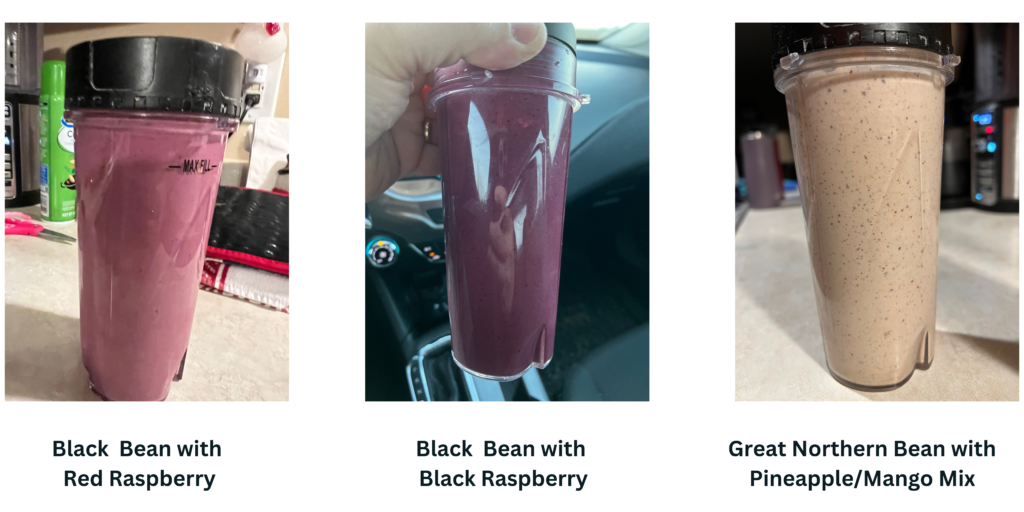
Remember what I said about legumes earlier? I CANNOT even taste the beans in these smoothies. And canned beans are super cost-effective. Black Beans have about 10 grams of fiber per 2/3 cup. Great Northern Beans have about 5 grams of fiber per 2/3 cup. I alternate between the two. I normally put in about 2/3 cup of beans, along with 2/3 cup of fruit (black or red raspberries have about 5 grams of fiber), and then 2/3 cup of 2% milk. Additionally, I add 1 scoop of Premier Protein Vanilla Powder, 2 tablespoons of PB2 Powdered Peanut Butter, and 1 1/2 tablespoons of Super Seeds. The end result is a 16-ounce smoothie with 442 calories, 12 grams of fat, 22 grams of fiber, 14 grams of sugar, and 40 grams of protein. (Pics of smoothies below)
I do try to use a lot of different varieties of ingredients in my smoothies to mix it up, but the vanilla protein powder tends to heavily influence the flavor. I love the protein and peanut butter powders that I use. They have a clean, non-gritty taste with a very smooth flavor. If you would like to see my spreadsheet or suggest a smoothie combo, please let me know in the comments.
As an Amazon Associate I earn from qualifying purchases.
Click on these links if you would like to check out the Premier Protein Powder (Vanilla), PB2 Powdered Peanut Butter, or the Better Body Foods Organic Super Seeds.